
BDIX Hosting Explained: When Bangladesh-Based Hosting Makes Sense
BDIX hosting is often promoted as a shortcut to faster websites in Bangladesh. The useful question is more precise: Will the network path between your visitors and your website be efficient? Server geography matters, but routing arrangements, congestion, caching, and application performance matter too.
Quick answer: BDIX-oriented domestic hosting can reduce network delay for some Bangladeshi visitors, but outcomes depend on ISP routing, origin performance, caching, and the actual audience. Compare measured page experiences, not claims about geography alone.
What BDIX means in practical terms
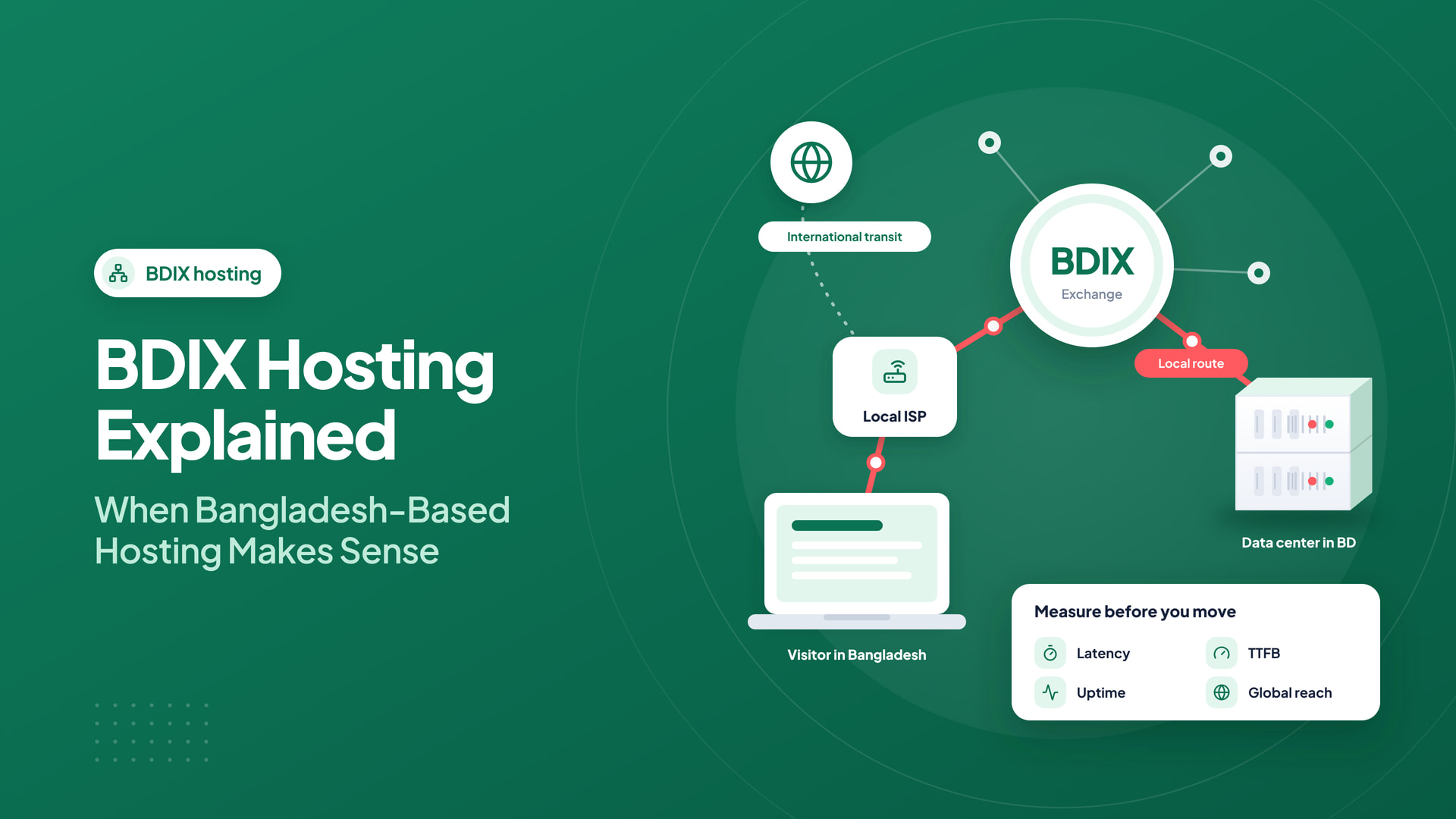
BDIX refers to the Bangladesh Internet Exchange, an environment that helps participating networks exchange domestic traffic. A website hosted on a server connected through suitable local networks may reach Bangladeshi users over shorter domestic routes instead of taking an unnecessary international path.
That possibility is valuable, especially for audiences concentrated in the country. Yet BDIX connectivity does not mean every internet provider will follow the same route, or that all pages will load instantly. Test from more than one Bangladeshi network before making performance claims.
Projects that may benefit from local hosting
A local news publication, school portal, neighborhood service directory, or Bangladeshi online shop may prefer domestic hosting when most visitors are in Dhaka, Rajshahi, Chattogram, or other parts of Bangladesh. Lower round-trip times can help with frequent small requests, such as logins or administrative actions.
On the other hand, an international software product may care more about global reach and multiple regions. Hosting inside Bangladesh is not automatically the best choice for an audience spread across several continents.
Four measurements worth checking
Latency: Run repeatable tests from several actual customer networks. A single speed test is not enough.
Time to first byte: Compare uncached responses as well as cached pages. Slow database queries can overwhelm any network advantage.
Availability: Review the provider’s service commitment and plan for occasional upstream problems.
International reach: Confirm overseas users can still access the site comfortably, particularly if you expect expatriate customers.
What to ask a BDIX hosting provider
Request the exact server location, approximate resource limits, backup schedule, and whether a content delivery network is supported. Ask how to test the network before transferring a production site. Be cautious about marketing claims that equate local hosting with guaranteed search rankings: search visibility depends on content, usability, technical health, and many other factors.
A useful starting point is to compare the features available in Intelwebhost’s hosting options for Bangladeshi websites while asking which location and routing arrangements apply to your chosen package. Confirm the current data-center location before ordering.
How local network routing changes a real request
When a customer opens a website, the browser must resolve its domain, establish a network connection, negotiate encryption, and request the page. A locally hosted origin can shorten one portion of that journey for users on networks with effective domestic peering. It does not eliminate DNS lookups, poorly optimized JavaScript, large images, or a slow database. A page that spends two seconds generating HTML will not become instant merely because the server is geographically nearby.
BDIX is an exchange-point concept rather than a guarantee that every network in Bangladesh uses the same route to every destination. Two visitors in the same city can experience different paths depending on their ISPs, mobile carriers, routing preferences, and congestion. This is why a hosting comparison should include fixed-line and mobile networks, not just one server-to-server ping.
A repeatable BDIX hosting evaluation
Choose a representative WordPress article page, an uncached admin or login action, and an image-heavy page. On every proposed hosting location, measure three things separately: connection latency, time to first byte, and total page transfer. Use the same site snapshot and repeat tests at several times of day. Note whether a CDN is enabled, because testing a cached CDN response is not the same as testing the origin server.
| Test | What it can reveal | Common misinterpretation |
|---|---|---|
| Ping or network latency | Round-trip network delay | “A low ping means WordPress is fast” |
| Time to first byte | Network plus origin response | “This measures only server hardware” |
| Largest Contentful Paint | Visible page-loading experience | “The data center alone determines it” |
| Checkout or login action | Dynamic application responsiveness | “A cached homepage proves everything works” |
Keep a spreadsheet of results with dates, ISPs, and test URLs. If you cannot measure at the provider before purchase, request a test IP or a demonstration site and ask how representative it is of the paid plan.
CDN, DNS, and fallback strategy
A Bangladesh origin can pair with a CDN to reach international visitors, although dynamic pages still depend on the origin and applications need appropriate cache rules. Configure long-lived caching for versioned images and CSS files. Avoid caching authenticated pages, cart contents, and other personalized responses. If a CDN introduces a regional routing issue, test bypassing it before deciding the web host is down.
Keep DNS TTLs appropriate for a planned migration, monitor authoritative nameservers, and maintain an independent backup outside the origin machine. If the website serves students, customers, or news readers during fixed peak hours, plan changes outside those periods. Local availability and global availability are separate operational considerations.
Case study: a Bangladesh-first publisher
Consider a hypothetical news website with most readers using Bangladeshi mobile networks. The site may benefit from efficient domestic routing, but its biggest delays might come from oversized thumbnails and uncached search queries. Start by reducing image payloads and adding page caching; then compare a domestic host with an overseas origin under identical conditions. If the Bangladesh origin wins consistently for the reader networks, location is a defensible choice. If the difference disappears after a CDN, prioritize stability and support rather than a geographic slogan.
Checklist for choosing domestic hosting
- Ask whether the plan is actually hosted in Bangladesh, not merely sold by a Bangladesh company.
- Request current details about local peering or test endpoints without assuming universal BDIX reachability.
- Check performance from multiple local ISPs and at least one mobile network.
- Compare dynamic as well as static page response times.
- Confirm international accessibility, backups, and escalation support.
- Measure performance again after deployment; routing can change over time.
A sensible deployment pattern
Put your origin server where your primary audience gets consistent results. Use caching for static resources, optimize images, and keep application code efficient. If you serve both local and international customers, test a CDN rather than relying on origin location alone.
BDIX hosting can be a strong fit for Bangladesh-focused projects, but it should win on measured user experience, not on the acronym printed in a product description.
Frequently asked questions
Is BDIX hosting the same as a CDN?
No. BDIX concerns local network traffic exchange. A CDN distributes or caches content at edge locations; the two can complement one another.
Will all Bangladeshi ISPs reach a BDIX-connected site equally fast?
No. Traffic paths and peering vary by provider, location, and time. Measure performance on networks that your visitors actually use.
Should international websites always avoid Bangladesh hosting?
Not necessarily. Evaluate audience distribution, latency, resilience, and CDN strategy instead of applying one rule to every project.